
Compile & Defend
About Compile & Defend
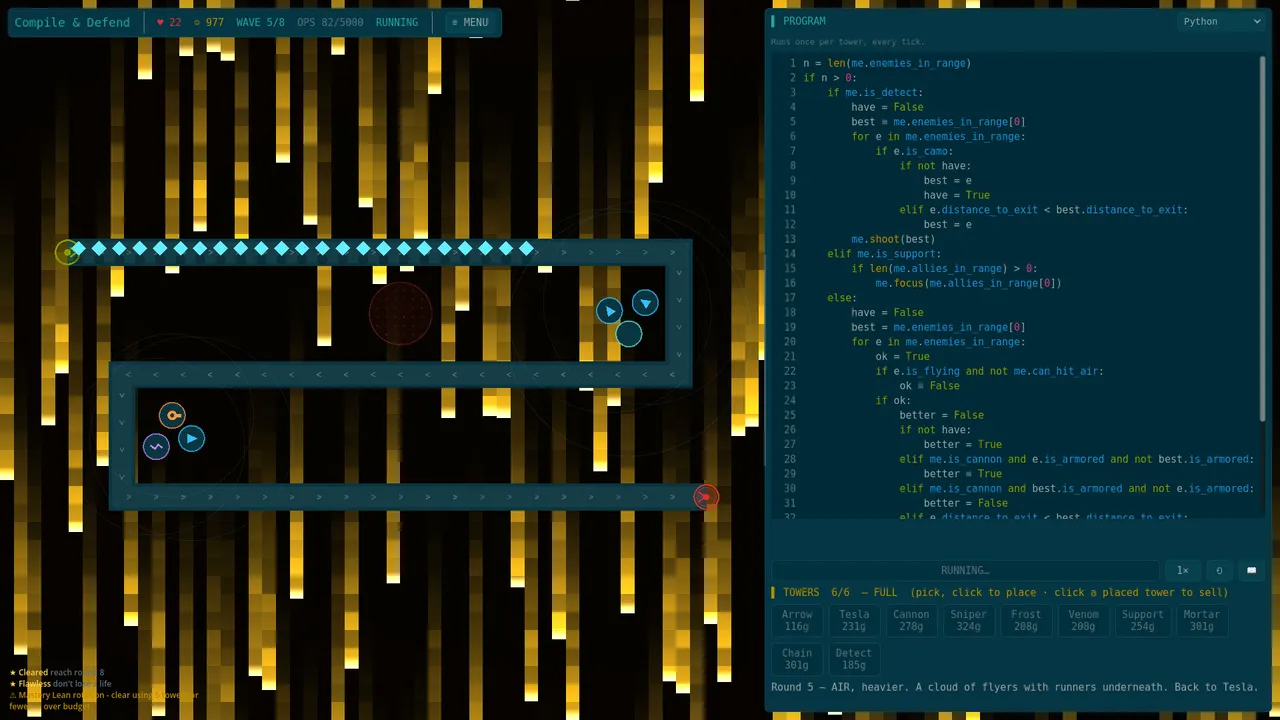
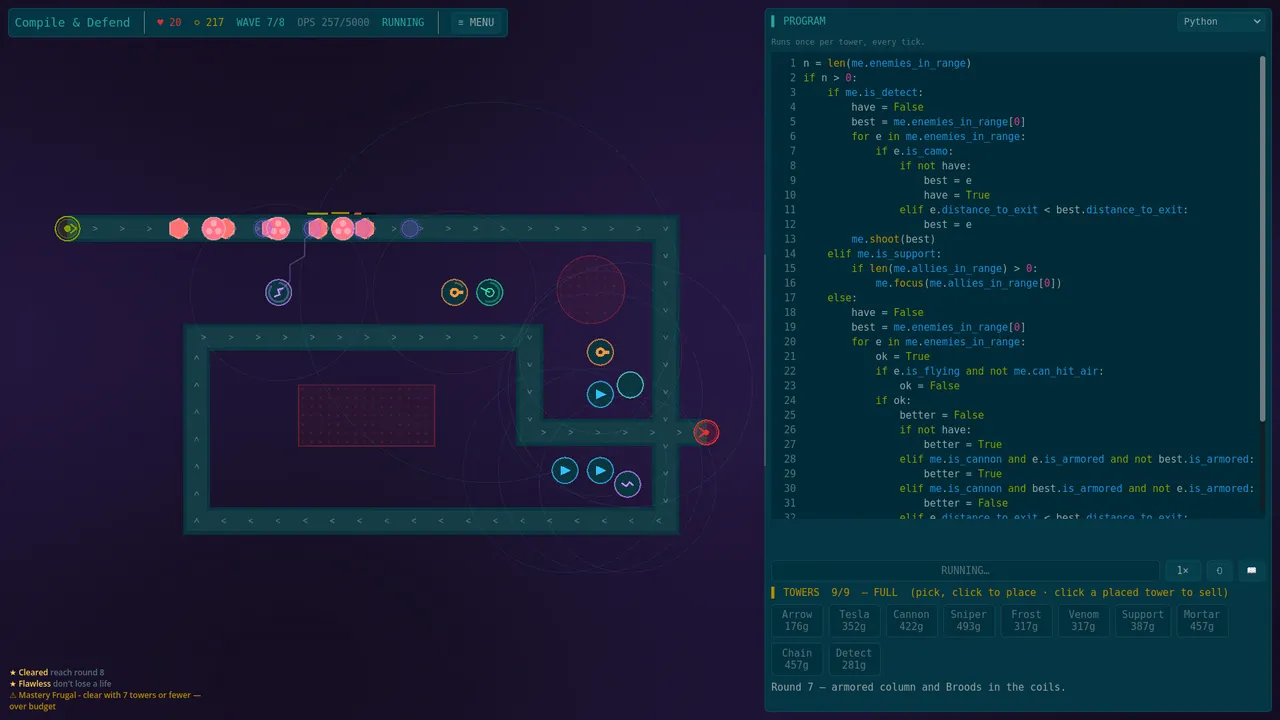
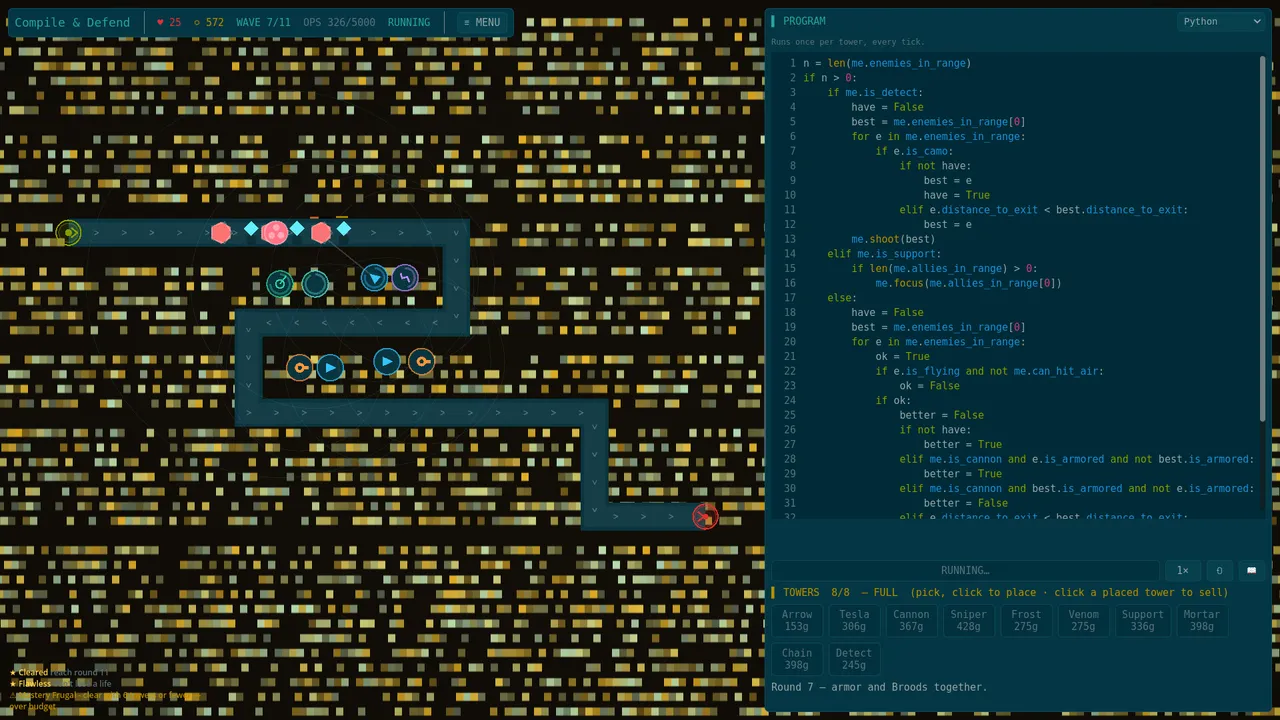
Compile & Defend inverts tower defense entirely: instead of placing towers and clicking enemies, you write the algorithms your towers execute every game tick. This is tower defense built for programmers, where the quality of your code matters more than the quantity of your defenses. The release date for Compile & Defend is July 20, 2026, launching on PC.
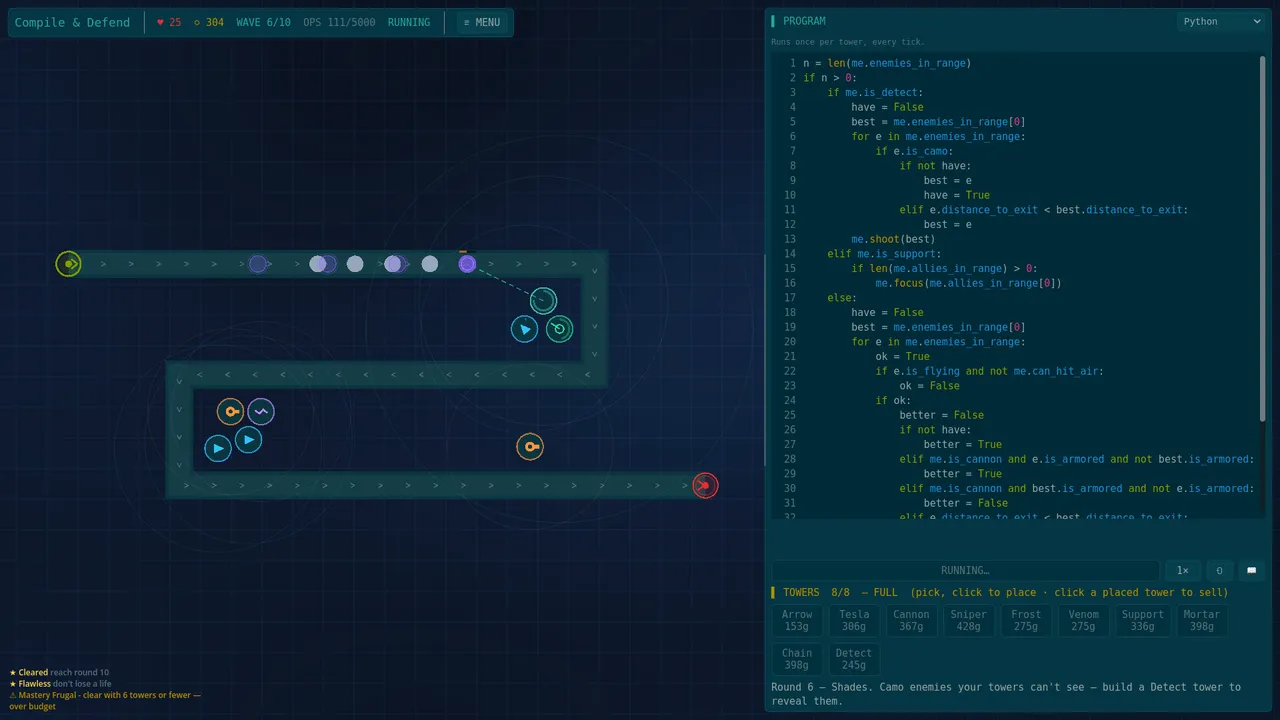
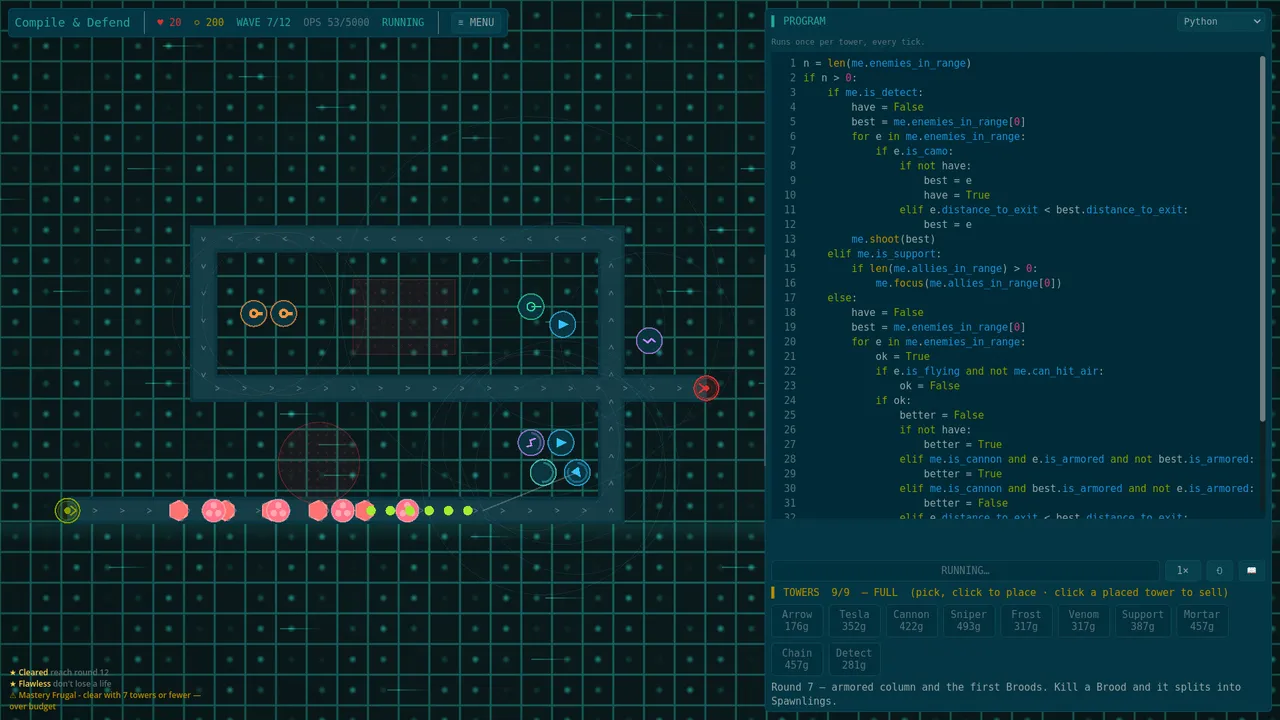
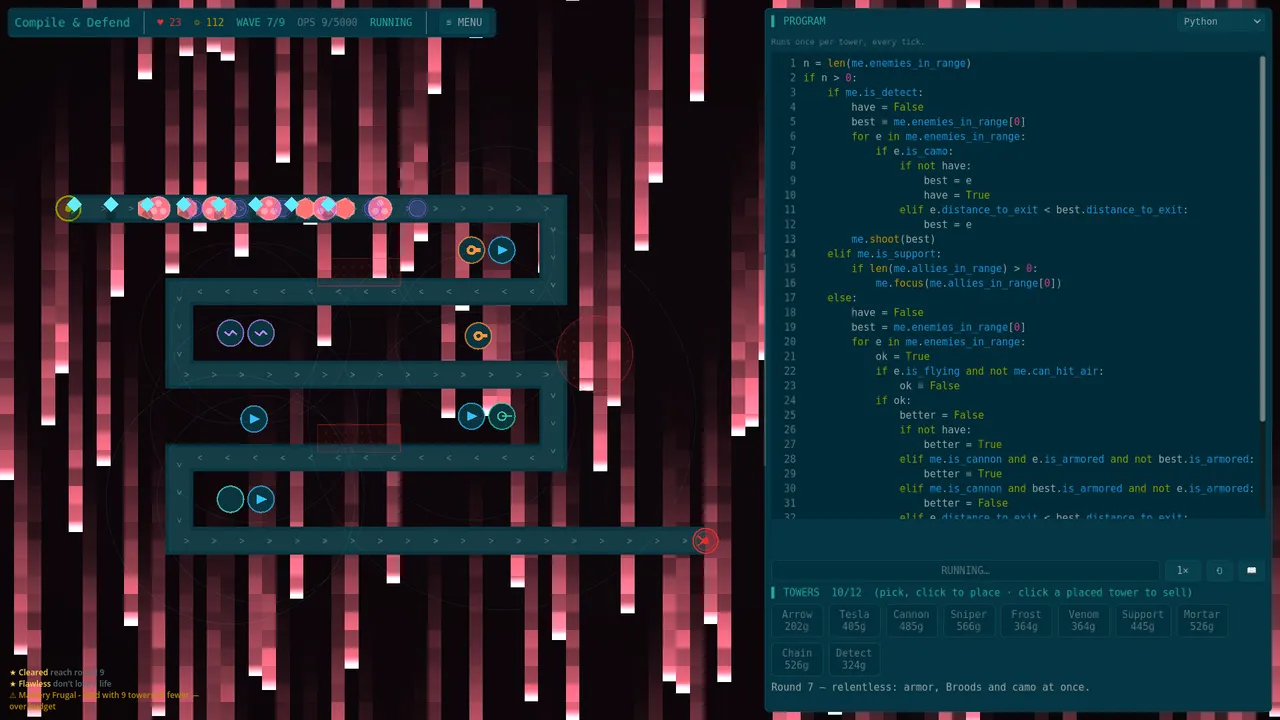
The core loop strips away all management except one thing: logic. Each tower on the map runs your script once per tick, evaluating enemies in range and deciding whether to shoot and at what target. There is no UI for targeting priority, no pause to reposition, no resource economy to balance. Your code is the entire defense. A naive script that shoots the closest enemy will hold the line until the swarm thickens and it becomes clear that closest is not always most dangerous—a basic target prioritisation rule written in an if-statement will begin to crack. Better algorithms—tracking which enemies deal the most damage per second, which are already wounded, which are moving fastest—beat adding more towers.
Write in Any Real Language
You choose from Python, JavaScript, C++, C#, Rust, Zig or Lua, all compiled to the same underlying engine. There is no proprietary scripting dialect to learn, and no penalty for switching languages mid-campaign if you want to experiment. This removes a major friction point in coding games: you write in the syntax you already know, or the syntax you want to practice. A Python player and a Rust player can take identical approaches to the same problem, just spelled differently.
The game exposes a clean API: me represents the tower, me.enemies_in_range is the list of visible targets, me.shoot(target) fires. From there the problem is purely algorithmic—you are not fighting the game engine or learning a domain-specific language, you are solving a genuine tactical problem in code. Debugging is built in: errors are numbered and line-specific, treating failed runs as learning moments rather than frustrations.
The Design Stake
Whether Compile & Defend can sustain tension across a full campaign is the question that matters. Tower defense works because difficulty curves, unit variety and the pressure of incoming waves create moment-to-moment decision-making. Here, decisions happen during the code-writing phase, not during the fight itself. Once a wave starts, you watch your algorithm execute; you cannot react or adjust. This means either the game's wave design is strong enough that watching your code succeed or fail is genuinely engaging, or the act of coding between rounds is engaging enough to carry the gaps. The teaching campaign hints that progression is meant to introduce new enemy types and tactical wrinkles that force code rewrites, not just harder numbers.
This is a natural fit for anyone who loves both programming and strategy games, and especially for players fatigued by the click-and-micromanagement demands of traditional tower defense. Anyone seeking real-time reaction gameplay or a traditional tower defense experience should look elsewhere. For programmers and algorithm enthusiasts willing to treat combat as a debug cycle, Compile & Defend offers a genuinely uncommon angle on a familiar genre.
Features
System requirements
Minimum
- OS
- Windows 10 (64-bit)
- Processor
- Intel Core i3 or equivalent (any x86-64 dual-core)
- Memory
- 1 GB RAM
- Graphics
- GPU with Direct3D 12 / Vulkan 1.0 support (Intel HD Graphics 500-series or better)
- DirectX
- Version 12
- Storage
- 150 MB available space
- Sound Card
- Any
- Additional Notes
- Keyboard required — the game is played by writing code.
Recommended
- OS
- Windows 11 (64-bit)
- Processor
- Intel Core i5 or equivalent
- Memory
- 2 GB RAM
- Graphics
- Any dedicated GPU or modern integrated graphics
- DirectX
- Version 12
- Storage
- 200 MB available space
- Sound Card
- Any
- Additional Notes
- Keyboard required — the game is played by writing code.





No comments yet. Be the first to share your thoughts.