

About Rails & Rivals
Rails & Rivals is a turn-based strategy board game built around a central economic tension: building the cheapest route is worthless if rivals own every track you need to cross. Released July 20, 2026 on PC, it strips railroad tycoon games down to their core system—laying track, delivering cargo, and managing cash flow—and rebuilds them as a competitive puzzle where every tile placement is a negotiation with your opponents' wallets.
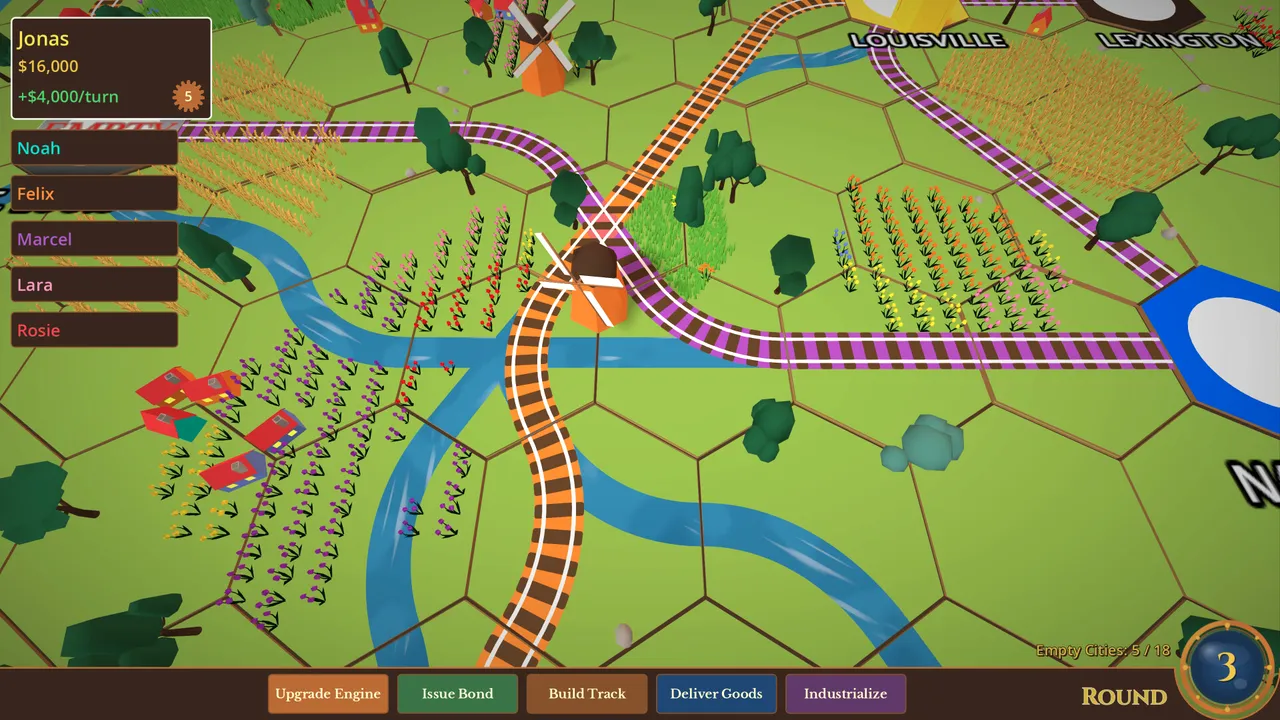
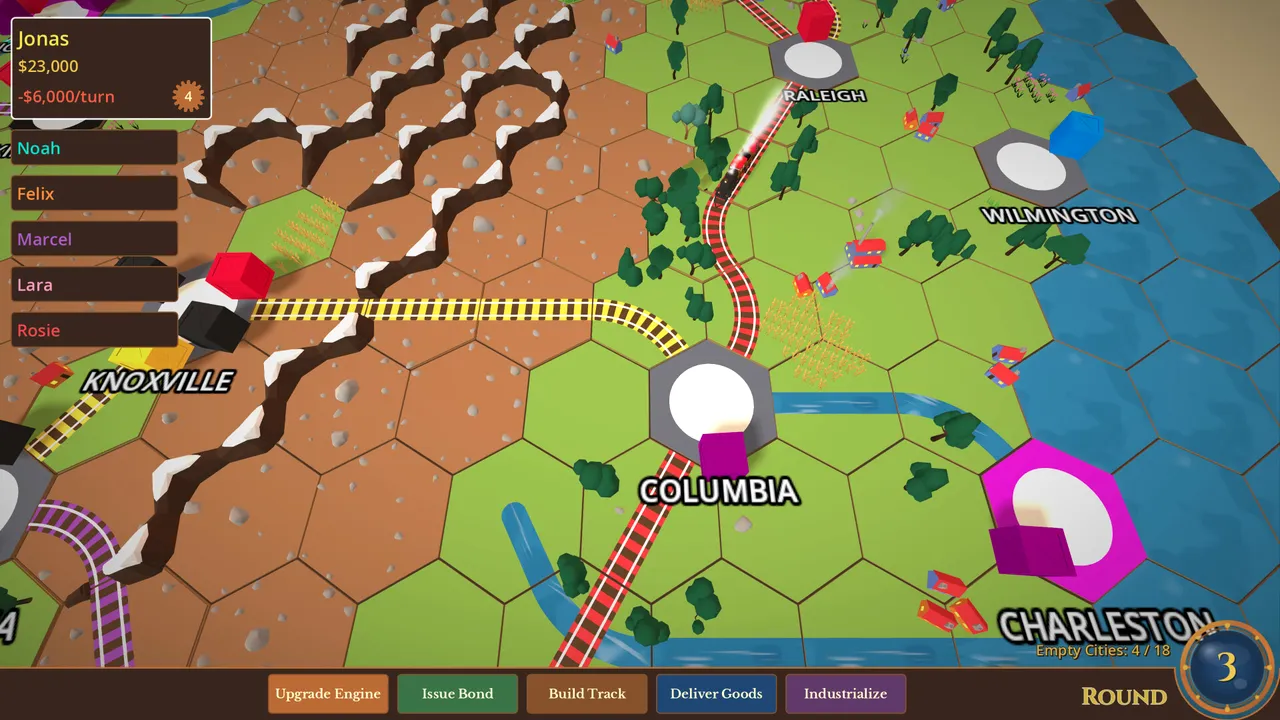
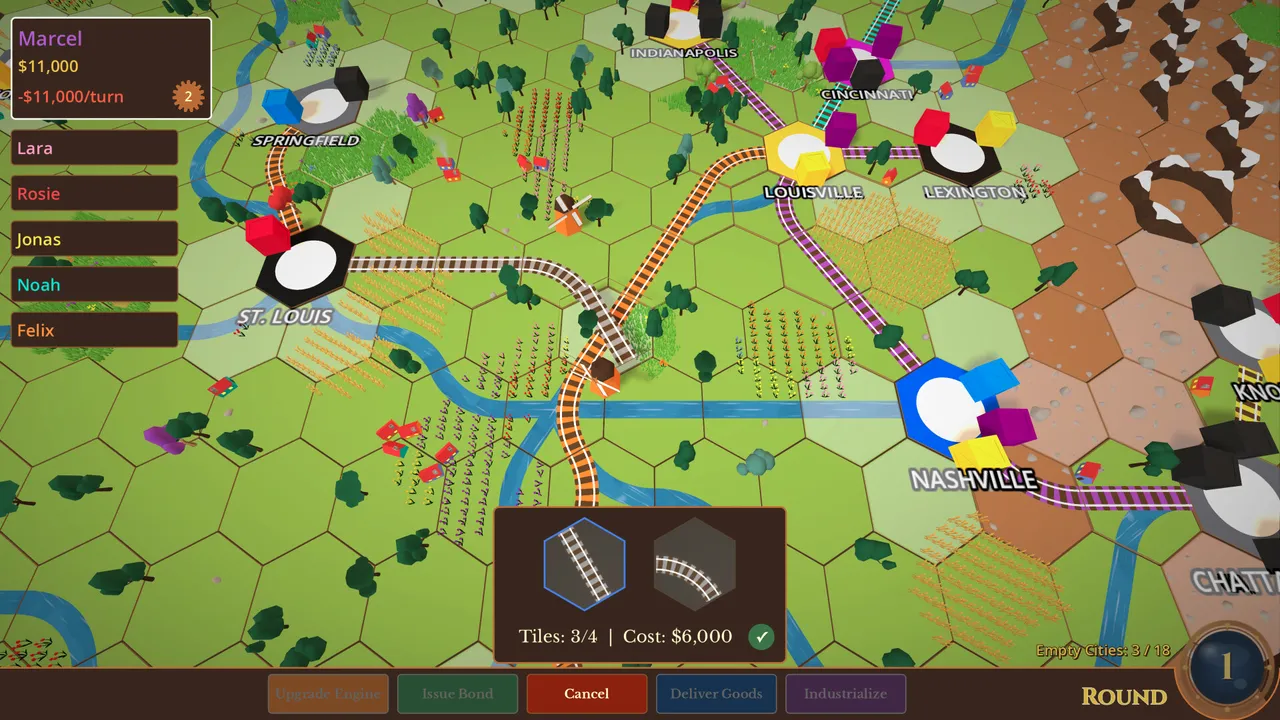
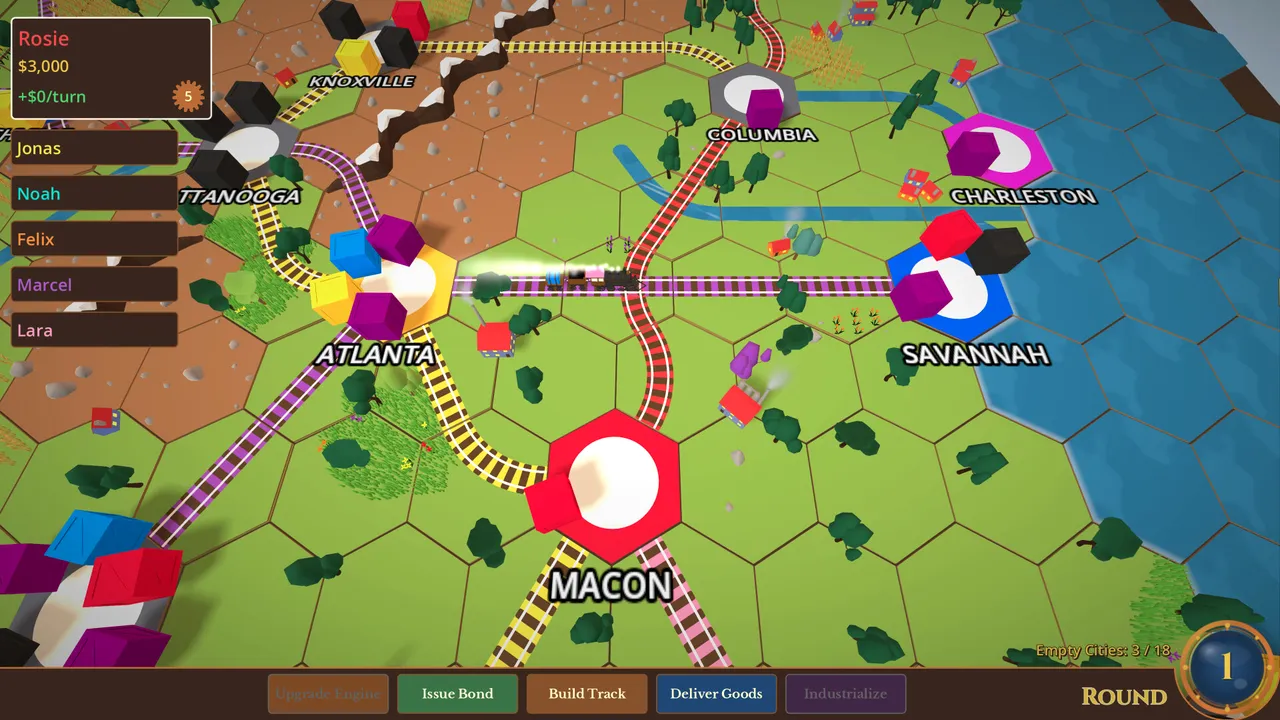
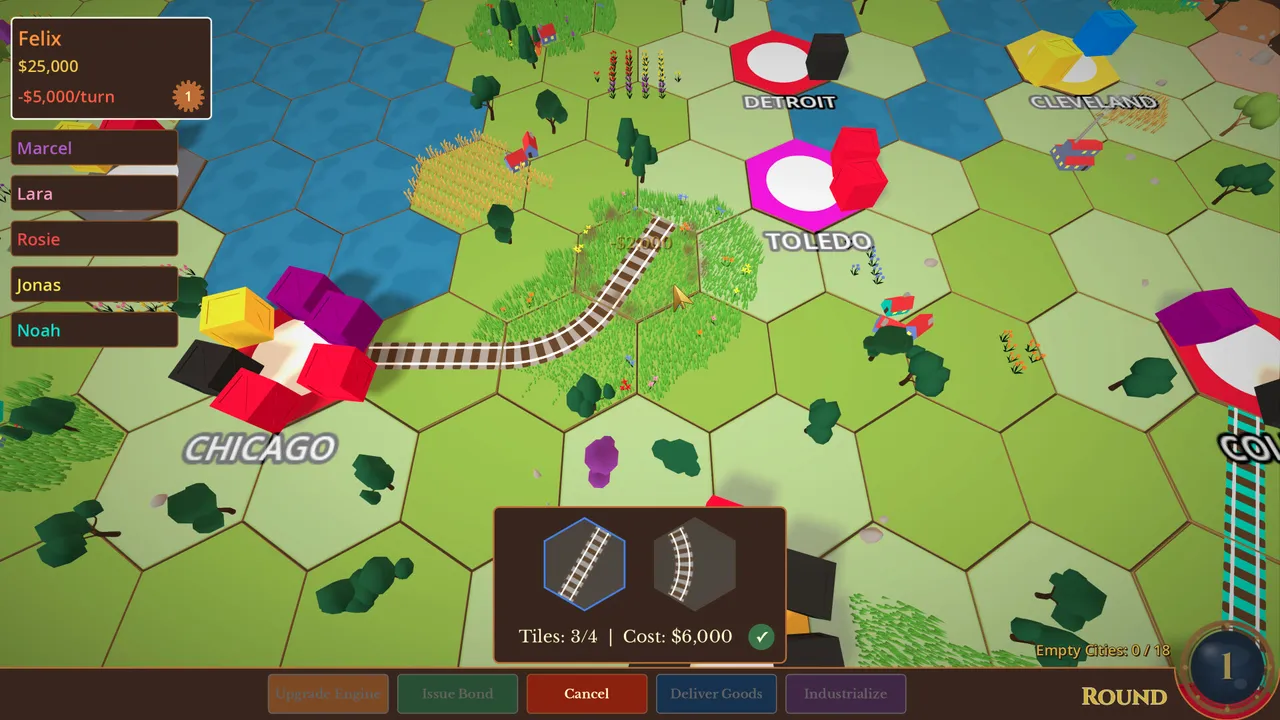
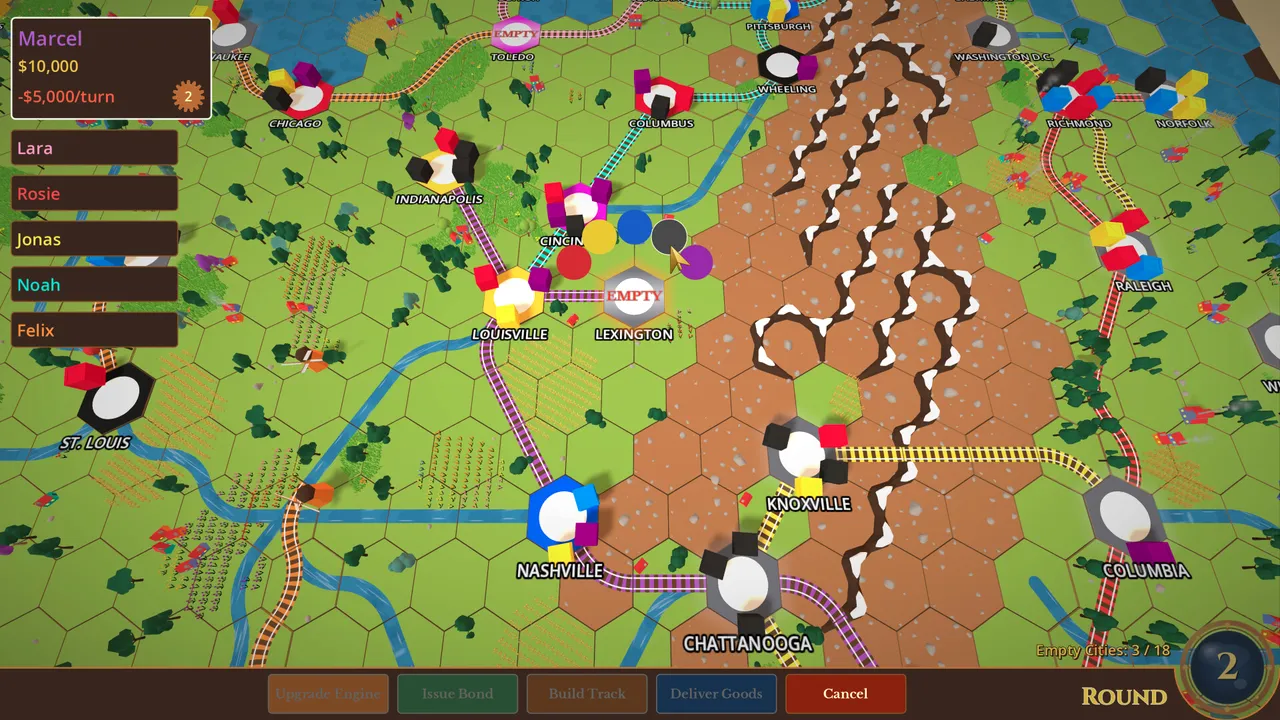
The game's fundamental loop runs on hex-terrain map traversal with explicit routing costs. Laying track has a static price determined by terrain: cheap across plains, expensive through mountains, and subject to additional tolls for rivers and ridges. But the real strategy emerges once the board fills. You earn money by delivering colored goods from their source cities to matching destinations, but every railroad segment you cross that belongs to a rival costs you a toll. This means the fastest route is often not the cheapest route, and sometimes the only viable path requires negotiating with opponents or taking expensive detours. The system forces players to balance immediate cargo income against long-term territorial control.
Financing your expansion: bonds and engine limits
Cash pressure escalates through a bonds mechanic that replicates historical railroad finance. Need fast capital to expand? Issue bonds that pay dividends every turn, bleeding your income for as long as they exist, and they cost victory points at the end of the game. This creates a permanent trade-off: borrow now to grab territory and dominate early, but spend the rest of the game paying for that advantage. There is no pure optimal strategy, only different bets on whether you can leverage an early lead into late-game dominance before interest costs mount.
Engine upgrades add a second progression axis. You start limited to delivering across a single link and must spend income to upgrade your engine up to level 8, which determines how far along your railroad network you can reach from a single city in one turn. This gates expansion naturally without arbitrary level systems, forcing new players to expand slowly at first and creating moments where an engine upgrade opens an entire region of the map.
Multiplayer, maps and the modding question
The release date for Rails & Rivals arrives with support for two to six players in online or local private lobbies, which sidesteps the worst of async-multiplayer friction and the randomness of public matchmaking. A built-in map editor lets you customize terrain, rivers, ridges, city placement and map size, then save and play on your creations. Whether this feature generates a genuine modding community or remains a novelty depends on whether the base game's strategic depth justifies repeated play on variant terrain, a question the first month will answer quickly. The game ships with multiple maps drawn from real-world geography, each imposing distinct city layouts and crossing penalties that should provide natural variety without custom content.
If you prize economic depth, negotiation-based competition and systems where every decision ripples across future turns, add this to your wishlist now. If you prefer single-player campaigns with scripted progression or want an economic game that lets you ignore your opponents, wait for reviews to see whether solo modes or AI depth exist.
Features
System requirements
Minimum
- OS
- Windows 10 (64-Bit)
- Processor
- Intel Core i5-10400 | AMD Ryzen 5 3600
- Memory
- 8 GB RAM
- Graphics
- NVIDIA GTX 1050 | AMD RX 560 | Intel Iris Xe
- Storage
- 2 GB available space
- Additional Notes
- Requires a 64-bit processor and operating system


No comments yet. Be the first to share your thoughts.